what are you looking for?

The rapid integration of non-dispatchable new energy generation—primarily solar PV and wind power—fundamentally transforms utility grid dynamics. Replacing traditional synchronous generators with inverter-based resources (IBRs) shifts the grid from a deterministic, high-inertia architecture to a stochastic, low-inertia system, necessitating advanced mitigation strategies and dynamic dispatch topologies to preserve grid frequency and voltage stability.
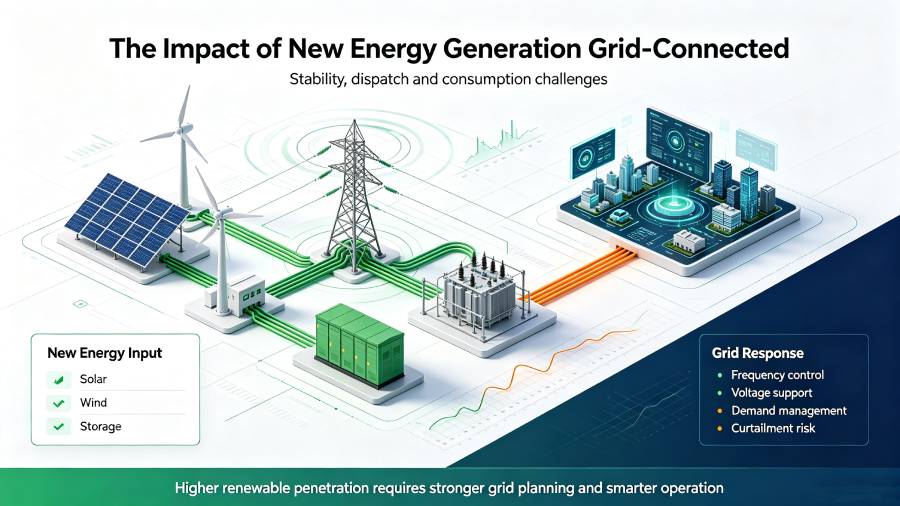
Interconnecting variable renewable energy sources triggers significant operational shifts across three primary electrical parameters:
Replacing massive synchronous turbine rotors with power electronics lowers total system inertia, driving higher Rate of Change of Frequency (RoCoF) and severe frequency deviations during sudden trips.
High-frequency switching in grid-tied inverters injects harmonic currents, while rapid weather-driven power swings induce local line voltage flicker and reactive power instability.
Solar overproduction during mid-day leads to deep net-load troughs, followed by extreme evening ramp-up demands that stress conventional fast-start peak generators.
| System Characteristic | Conventional Thermal/Hydro Grid | High-Penetration Renewable Grid |
|---|---|---|
| Source Predictability | Deterministic and fully dispatchable | Stochastic and weather-dependent |
| Short-Circuit Ratio (SCR) | High SCR (Strong system strength) | Low SCR (Weak grid conditions at remote nodes) |
| Power Flow Direction | Unidirectional (Central Gen → Load) | Bidirectional (Distributed generation backfeed) |
| Primary Frequency Control | Governor response + Physical kinetic inertia | Synthetic inertia + Battery Energy Storage (BESS) |
Quantifying grid robustness under high renewable penetration requires analytical modeling of system inertia and localized voltage stability limit metrics:
As effective system inertia (H_sys) declines, even minor load imbalances (ΔP) trigger steep frequency drops, risking widespread Under-Frequency Load Shedding (UFLS).
In low SCR zones, standard Grid-Following (GFL) inverters risk Phase-Locked Loop (PLL) instability, necessitating transition to Grid-Forming (GFM) control topologies.

 Monday -Sunday: 8:00 - 24:00
 No.13 Shang Zhen East RD., Taihe Town Baiyun Area, Guangzhou China
 info@futuregreenbattery.com