what are you looking for?

A Commercial & Industrial (C&I) Energy Storage Cabinet is a highly integrated, intelligent solution combining battery packs, a Battery Management System (BMS), Energy Management System (EMS), Power Conversion System (PCS), thermal management, and fire suppression into a single enclosure. Serving as a crucial node in distributed energy networks and microgrids, it plays a vital role in peak shaving, dynamic capacity expansion, emergency backup power, and renewable energy integration.
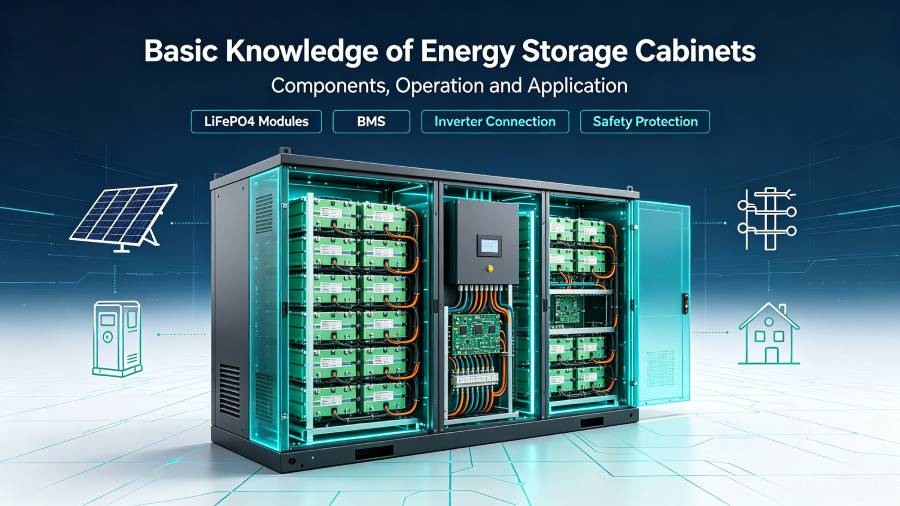
Modern energy storage cabinets adopt an "All-in-One" design approach, housing six critical subsystems within an IP54/IP55 weather-resistant outdoor enclosure:
Utilizes long-life Lithium Iron Phosphate ($\text{LiFePO}_4$) cells connected in series and parallel to form modules and strings, delivering high safety and high energy density DC storage.
Employs a 3-tier architecture (BMU-BCU-BMS) for real-time monitoring of voltage, current, temperature, SOC, and SOH while performing cell balancing and thermal runaway prevention.
Handles bi-directional AC/DC power conversion—rectifying grid AC power into DC to charge batteries, and inverting battery DC power to AC for load consumption during discharge.
Available in Air Cooling and Liquid Cooling topologies. Maintains inter-cell temperature variance within tight thresholds (liquid cooling achieves $\Delta T \le 3^\circ\text{C}$), extending lifespan.
Includes multi-stage gas detectors ($\text{CO}$/Combustible Gas/Smoke), PACK-level targeted agents (FK-5-1-12/Aerosol), and water sprinkler linkage for comprehensive protection.
Acts as the intelligent controller of the cabinet, aggregating data, executing charge/discharge dispatch strategies, anti-backfeed controls, and TOU rate arbitrage algorithms.
| Evaluation Metrics | Air-Cooled ESS Cabinet | Liquid-Cooled ESS Cabinet |
|---|---|---|
| Cooling Medium & Mechanism | Forced air convection flow | Liquid coolant conduction via cold plates |
| Cell Temp Uniformity ($\Delta T$) | Moderate ($\le 5^\circ\text{C} \sim 8^\circ\text{C}$) | Superior ($\le 2^\circ\text{C} \sim 3^\circ\text{C}$) |
| Energy Density & Footprint | Air duct spacing requires larger footprint | High density; saves up to 30%+ footprint |
| Auxiliary Power Consumption | Higher fan power draw; lower overall efficiency | Lower parasitic load; boosts RTE by 2%–3% |
| Initial CAPEX & Maintenance | Lower upfront CAPEX; simple maintenance | Higher upfront CAPEX; requires coolant inspection |
Dimensioning a C&I energy storage cabinet requires engineering calculations aligned with site load curves, TOU tariff schedules, and transformer capacities:
Charging during off-peak hours and discharging during peak rates twice daily significantly accelerates the project ROI pay-back period.
By discharging power when site demand approaches contracted power thresholds, the EMS shaving strategy lowers monthly utility demand charges.

 Monday -Sunday: 8:00 - 24:00
 No.13 Shang Zhen East RD., Taihe Town Baiyun Area, Guangzhou China
 info@futuregreenbattery.com