what are you looking for?

Selecting the optimal tilt angle for solar photovoltaic (PV) modules is a fundamental engineering decision that directly governs daily irradiance capture, seasonal yield profiles, and overall Levelized Cost of Energy (LCOE). Beyond geographic latitude, proper tilt selection balances seasonal sun paths, local atmospheric conditions, self-cleaning requirements, and structural wind-loading dynamics.
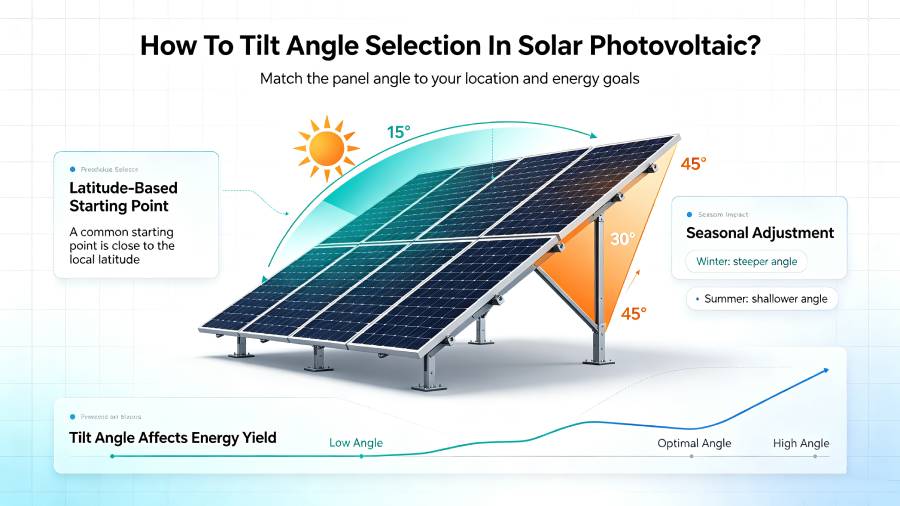
Determining the ideal inclination involves evaluating several key meteorological and environmental drivers:
The primary baseline for tilt estimation. Latitude determines the solar elevation angle throughout the year, dictating the median position for year-round yield optimization.
Off-grid systems with high winter loads require steeper angles to capture low-altitude winter sun, whereas summer-peak grid-tied arrays favor flatter inclinations.
Panels angled below $10^\circ \sim 15^\circ$ lose natural rainfall cleaning capability, leading to accelerated dust accumulation and severe soiling degradation.
| Optimization Objective | Recommended Formula (Tilt $\beta$) | Primary Operational Benefit |
|---|---|---|
| Maximum Annual Yield (Fixed-Tilt) | $\beta \approx \text{Latitude} \times 0.9$ (or $\text{Latitude} - 2.5^\circ$) | Maximizes total annual kWh output; ideal for grid-tied systems. |
| Winter Peak Yield (Off-Grid Critical) | $\beta \approx \text{Latitude} + 15^\circ$ | Compensates for low winter solar elevation and shorter day lengths. |
| Summer Peak Yield (Irrigation / Cooling) | $\beta \approx \text{Latitude} - 15^\circ$ | Captures high midday overhead sun; optimizes summer pumping/cooling. |
| Seasonal Manual Adjustment (2-Position) | Summer: $\text{Lat} - 10^\circ$ | Winter: $\text{Lat} + 10^\circ$ | Increases annual energy harvest by 5% to 8% with minimal mechanics. |
To accurately compute the incident radiation on a tilted surface ($I_T$), use the following solar position equations:
Higher tilt angles increase structural wind resistance ($C_f$ pressure coefficients). On flat commercial roofs, a reduced $10^\circ \sim 15^\circ$ tilt is often chosen to minimize ballast weight and structural racking costs.
For bifacial PV arrays, increasing ground clearance ($>1.0\,\text{m}$) and opting for slightly higher tilt angles ($+5^\circ$) significantly boosts rear-side albedo gain from highly reflective ground surfaces.

 Monday -Sunday: 8:00 - 24:00
 No.13 Shang Zhen East RD., Taihe Town Baiyun Area, Guangzhou China
 info@futuregreenbattery.com