what are you looking for?

While solar panels and inverters capture the spotlight in system procurement, wiring topology represents the critical electrical backbone that dictates system safety, energy conversion efficiency, and long-term reliability. Choosing between Series, Parallel, or Hybrid Series-Parallel configurations alters string voltages, current flows, voltage drop, and thermal risks—making it a hidden design decision that can literally make or break your photovoltaic performance.
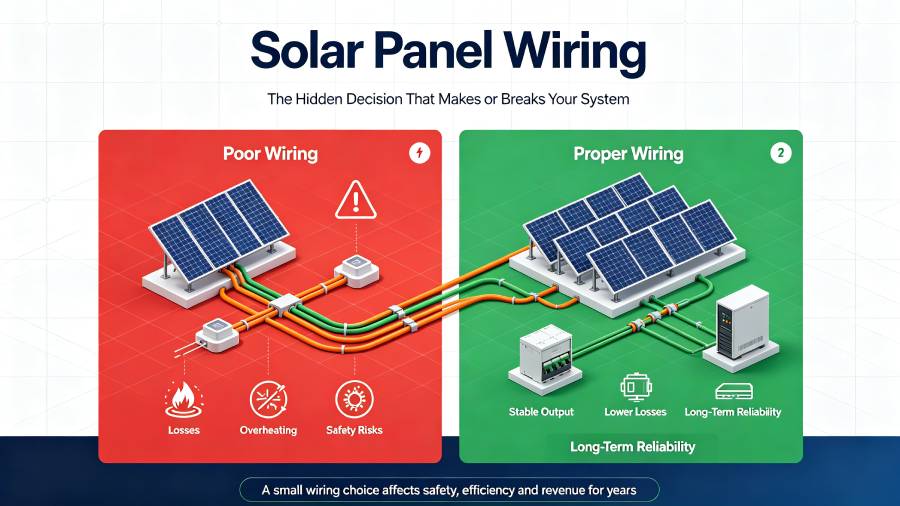
Suboptimal wiring design causes severe hidden losses and safety hazards long before equipment failure becomes visually obvious:
Undersized conductors or long low-voltage parallel runs generate high amperage ($I$), transforming valuable kWh generation directly into wasted heat along cable runs.
In a pure series string without MLPEs, partial shading on a single panel drags down the operating current ($I_{mp}$) of the entire string, causing drastic power drops.
High current parallel wiring increases stress on MC4 connections. Loose crimps or cross-matched connector brands induce high resistance, thermal degradation, and DC arcs.
| Electrical Parameter | Series Connection (Daisy Chain) | Parallel Connection (Branch) |
|---|---|---|
| Total System Voltage ($V_{total}$) | Additive ($V_1 + V_2 + ... + V_n$) | Constant ($V_{total} = V_{panel}$) |
| Total System Current ($I_{total}$) | Constant ($I_{total} = I_{panel}$) | Additive ($I_1 + I_2 + ... + I_n$) |
| Cable Gauge Requirement | Thinner wire gauge (e.g., 4mm² / 6mm²) | Thicker wire gauge (Higher AWG cost) |
| Inverter MPPT Startup Speed | Fast (Reaches MPPT min $V_{dc}$ rapidly) | Slower (Requires boost stage or low voltage) |
| Shading Impact Severity | High (Unless bypass diodes/optimizers act) | Low (Unshaded panels maintain full output) |
Calculating string sizing and conductor cross-sectional areas requires precise thermal and voltage drop considerations:
While electrical codes allow up to 3% voltage drop, designing DC homeruns for under 1% voltage drop maximizes cumulative yield and pays back larger wire costs rapidly.
Panels generate higher open-circuit voltage in winter. Failing to account for negative temperature coefficients ($\alpha_{Voc}$) risks frying inverter MPPT inputs on freezing mornings.

 Monday -Sunday: 8:00 - 24:00
 No.13 Shang Zhen East RD., Taihe Town Baiyun Area, Guangzhou China
 info@futuregreenbattery.com