what are you looking for?

Winter conditions present a unique paradox for solar photovoltaic (PV) systems: while low ambient temperatures boost silicon cell conversion efficiency, challenges like reduced daylight hours, low solar elevation angles, snow coverage, and heavy cloud cover can diminish energy yield. Understanding thermal dynamics, albedo gains, and operational optimization strategies is essential for maintaining high winter energy reliability.
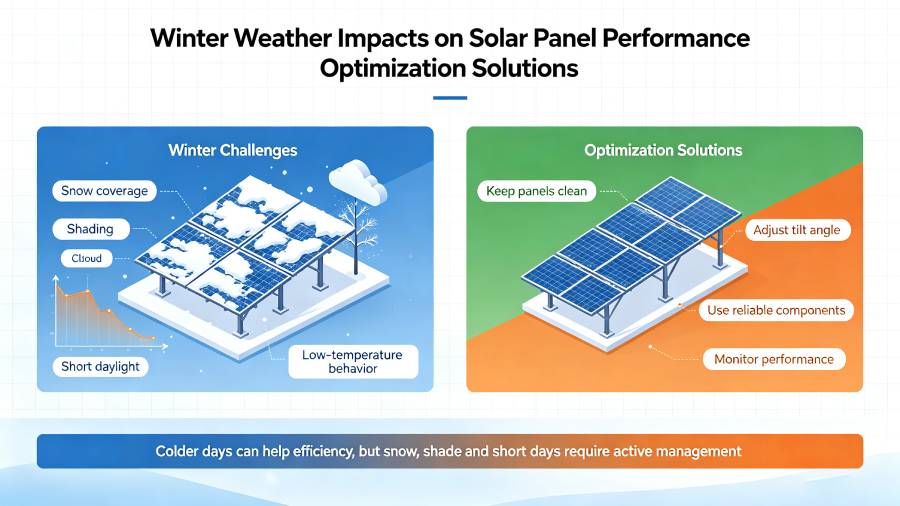
Winter operational performance is governed by several competing environmental and electrical factors:
Solar panels operate more efficiently at low temperatures. A negative temperature coefficient ($\gamma_{Pmp} \approx -0.3\%/^\circ\text{C}$) means panels produce higher open-circuit voltage ($V_{oc}$) in freezing conditions.
Fresh snow features an extremely high surface albedo ($0.80 \sim 0.90$). Bifacial modules capture this scattered rear-side light, significantly offsetting low front-side solar radiation.
Heavy snow accumulation obstructs irradiance completely, while a lower winter solar elevation increases atmospheric light absorption and intra-row array shading.
| Winter Parameter | Operational Challenge | System Performance Opportunity |
|---|---|---|
| Freezing Ambient Temps ($<0^\circ\text{C}$) | Higher $V_{oc}$ risks exceeding inverter max DC voltage limit | $+5\% \text{ to } +15\%$ silicon efficiency gain over STC ($25^\circ\text{C}$) |
| Snow Accumulation | Complete optical blockage; localized string mismatch loss | Dark panels absorb thermal radiation, enabling self-shedding |
| Ground Snow Cover (High Albedo) | Reflected glare requires proper sensor calibration | Bifacial rear-side gain increases by up to $+20\% \sim +30\%$ |
| Short Day Length / Low Sun Angle | Reduced peak sun hours (PSH); increased inter-row shading | Steeper tilt angles maximize direct irradiance capture |
Engineers must adjust electrical and mechanical parameters using cold-climate formulas:
Always calculate maximum string length using historical record minimum ambient temperatures ($T_{min\_ambient}$) to prevent damaging string inverters on bright, freezing mornings.
Maintain sufficient ground clearance ($>1.0\,\text{m}$) below array bottom edges to prevent sloughed snow from dams that block module bottom cell rows.

 Monday -Sunday: 8:00 - 24:00
 No.13 Shang Zhen East RD., Taihe Town Baiyun Area, Guangzhou China
 info@futuregreenbattery.com