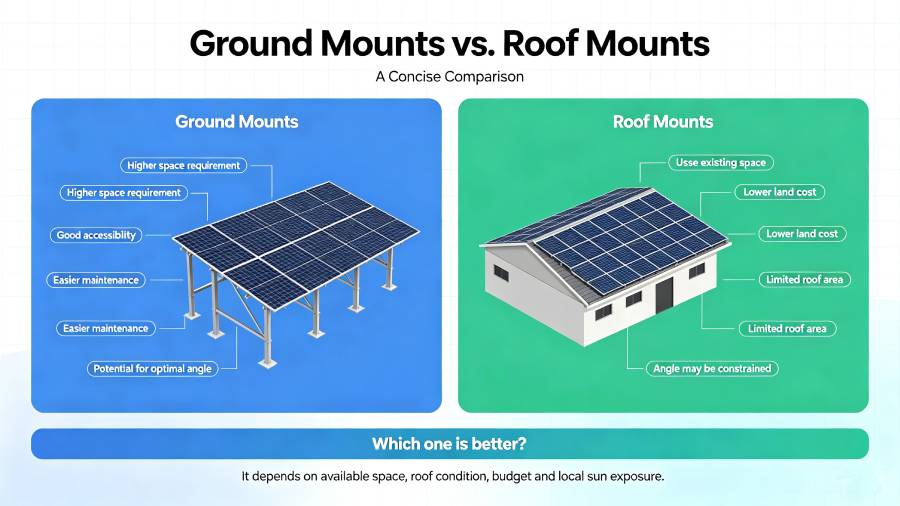
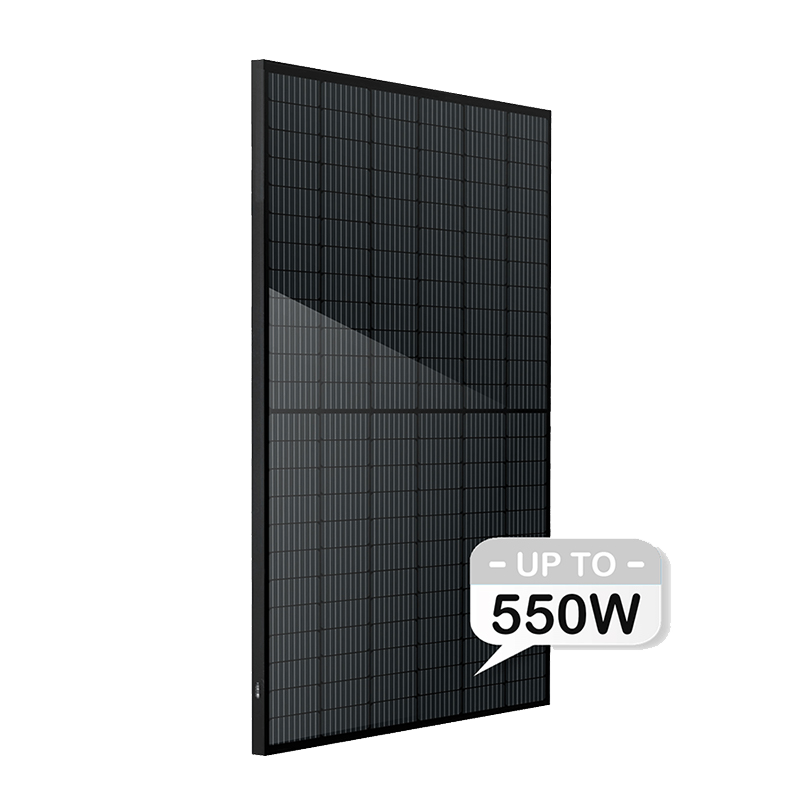
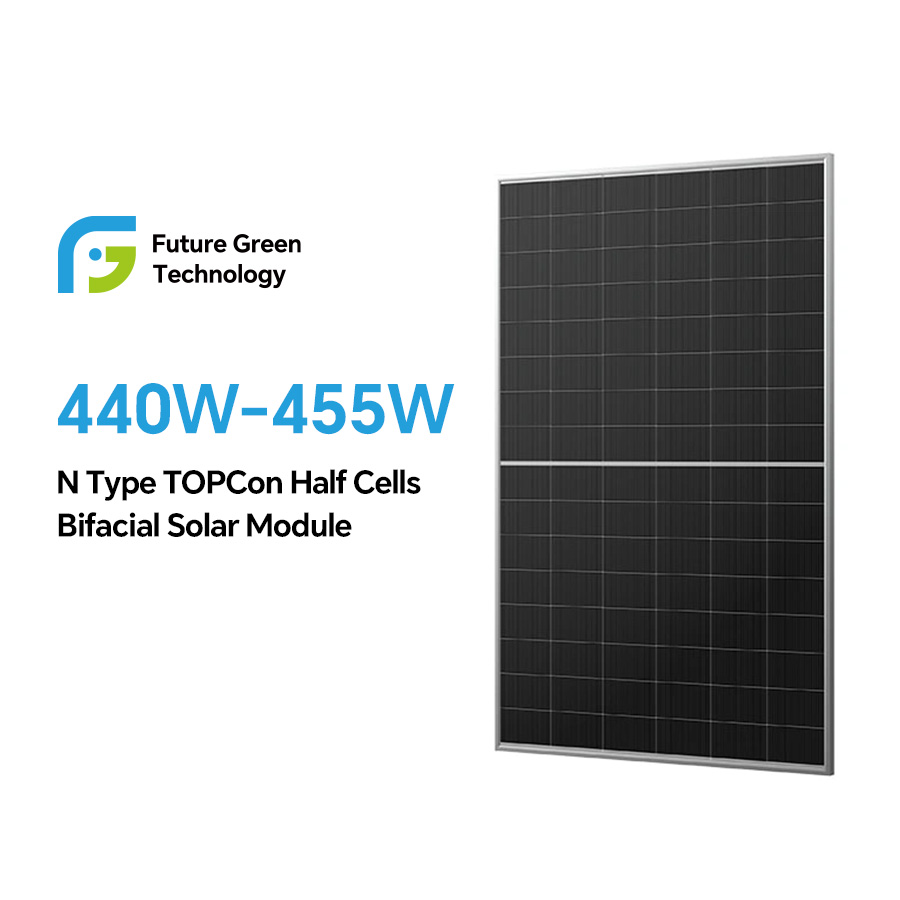
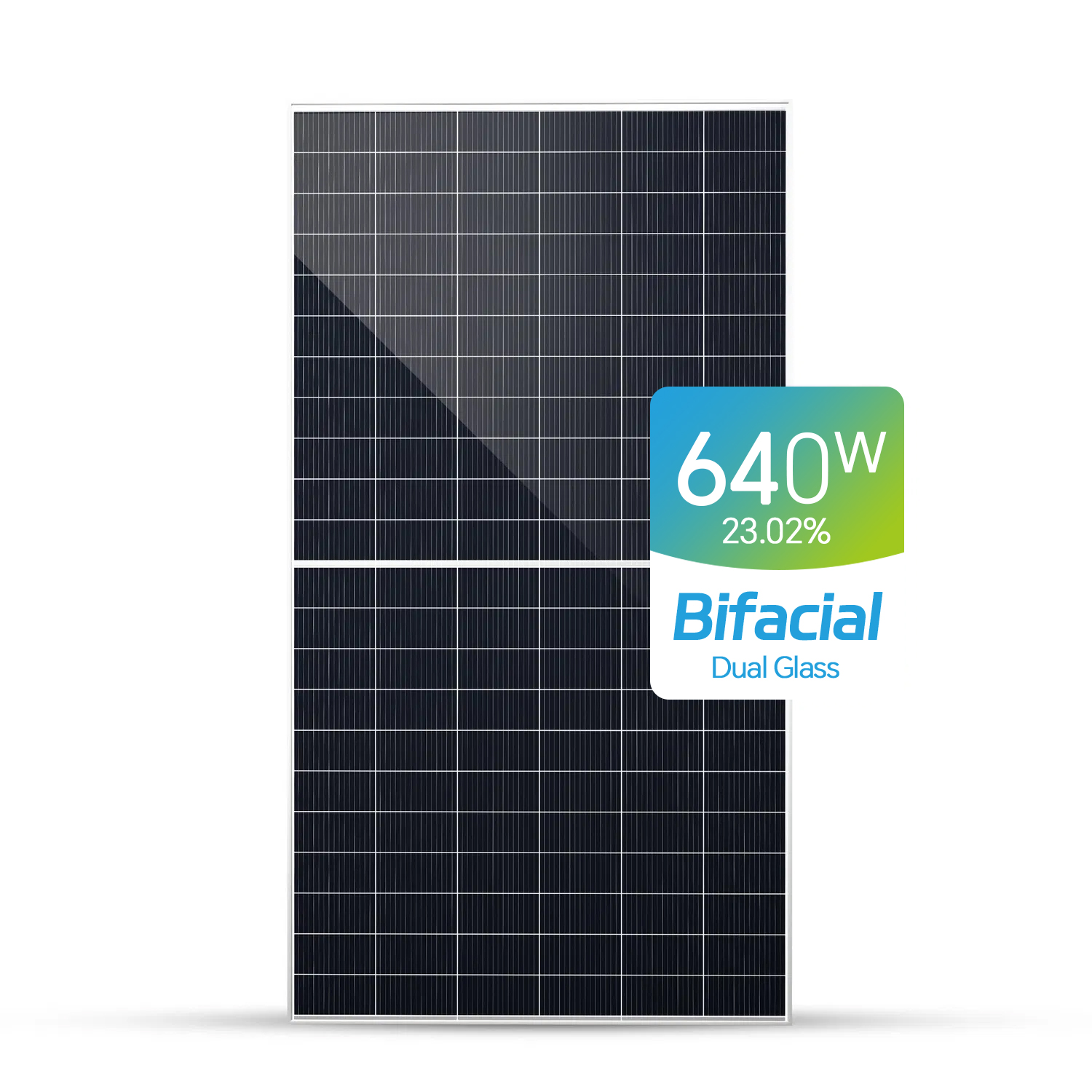
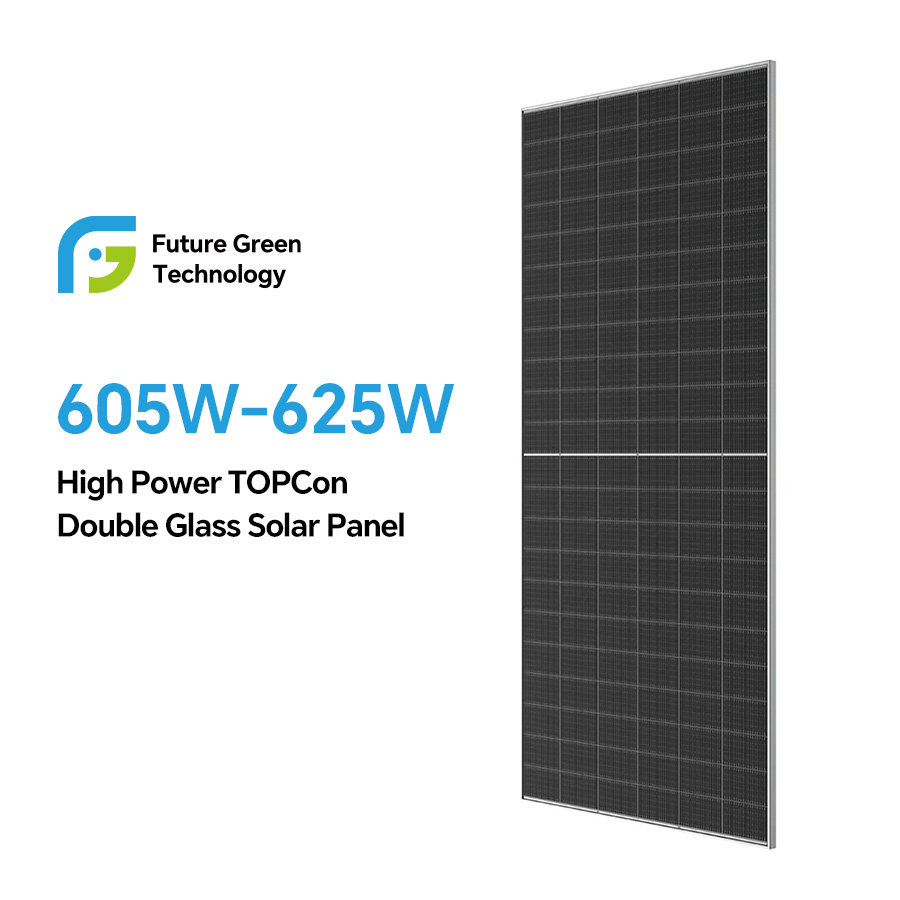
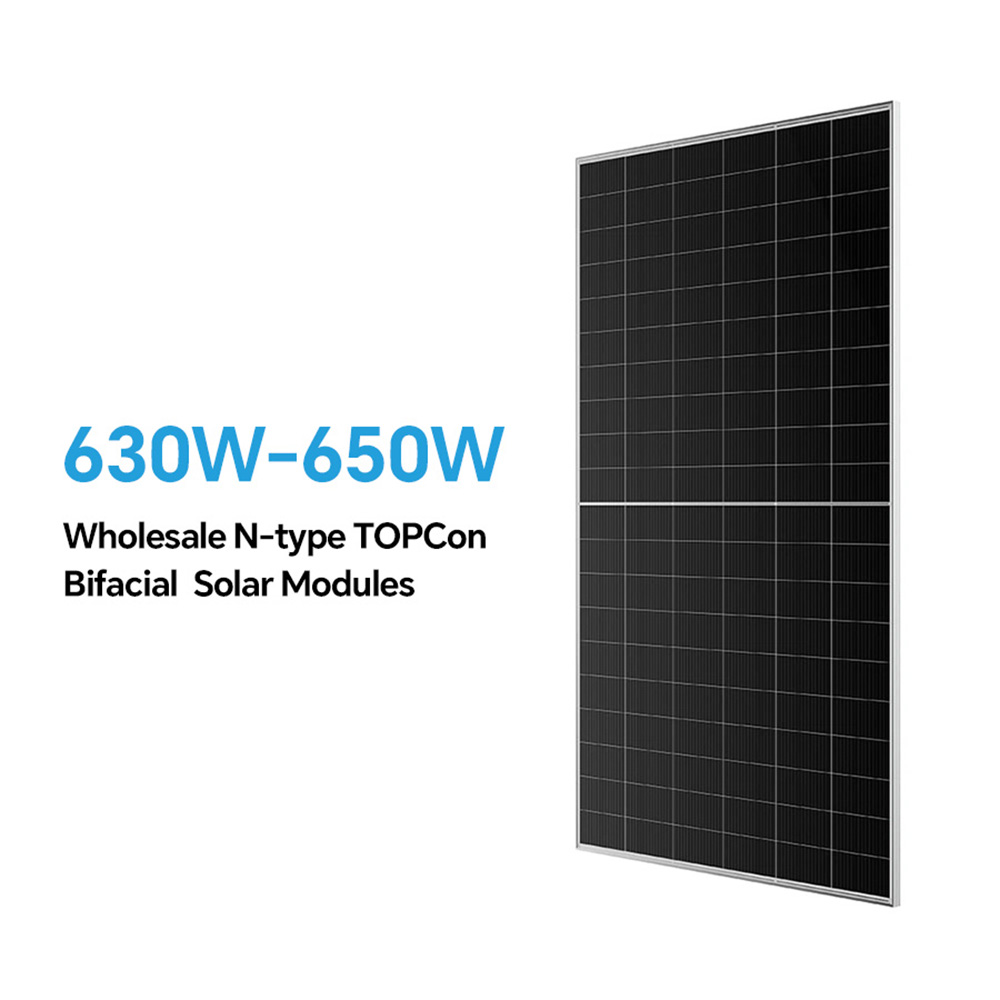
Roof-mounted solar systems are more cost-effective, as they leverage the existing roof structure as a foundation and occupy minimal land space. In contrast, ground-mounted systems demand more land area but offer easier accessibility for installation, maintenance, and repairs. What’s more, they allow for flexible adjustment of the solar array’s orientation to boost energy generation efficiency.
After selecting your solar panels, the next step is to choose the ideal mounting system that aligns with your living space, budget, and energy consumption requirements.
Solar panel mounting solutions mainly fall into two categories: roof mounts and ground mounts. Roof-mounted systems are secured to roof-mounted brackets, while ground-mounted systems are installed on foundations built at ground level. Refer to the comparison images below for visual examples.
Each mounting type has its own set of advantages and disadvantages, and their suitability varies based on the specific parameters of your project. Discover our top recommendations for solar panel mounting systems.
In this article, we’ll elaborate on the key factors we consider when advising customers on choosing between ground-mount and roof-mount racking systems.
First, let’s look at a brief overview:
Ground-Mounted Solar Panels
Advantages
Simple to access for operation and maintenance
Convenient for regular cleaning
Troubleshooting becomes more straightforward
The racking structure is more robust overall
System layout is not restricted by roof dimensions
Lower panel temperatures translate to higher energy output
No need to remove panels when replacing the roof
Disadvantages
Installation involves more labor and is more time-consuming
Higher upfront installation costs
Requires a larger quantity of installation components
The permitting process incurs additional expenses
Occupies valuable land area
May not meet everyone’s aesthetic expectations
Roof-Mounted Solar Panels
Advantages
More budget-friendly overall
Fewer installation materials are needed
Lower labor costs for installation
Makes full use of underutilized roof space
The permitting process is more streamlined
Disadvantages
Difficult to access, especially for steep or slippery roofs
Troubleshooting system faults is more challenging
Higher panel temperatures lead to reduced energy output
Roof size limitations restrict the maximum capacity of the solar system
Roof replacement during the panel’s service life will require reinstalling the system, causing inconvenience
Why Choose Ground-Mounted Solar Systems?
Optimal Orientation for Maximum Sunlight
Regardless of the type of solar system you’re evaluating, one fundamental principle holds true: solar arrays perform best when they can capture the maximum amount of sunlight.
For locations north of the equator, the sun is positioned in the southern sky as the Earth rotates. Therefore, aligning the solar array to face due south will maximize daylight capture and optimize energy production. Conversely, for areas south of the equator, a due-north orientation is more efficient.
Achieving this optimal alignment can be challenging with roof-mounted systems, as roof orientations rarely align perfectly with the sun’s path.
Ground-mounted systems, however, offer full flexibility in orientation. You can adjust the array to the optimal angle, ensuring it faces the sun directly at all times. This adjustability alone makes ground-mounted systems more efficient, as they maximize sunlight exposure for energy generation.
Efficiency Benefits for Both Off-Grid and Grid-Tied Users
Optimal orientation is not the only factor that enhances the efficiency of ground-mounted arrays. Elevating the panels off the ground improves air circulation, which effectively cools the panels and further boosts energy output.
Most solar panels are tested under standard conditions with an average temperature of 77°F, which simulates a typical sunny day without extreme heat. However, when panel temperatures exceed this threshold, their efficiency declines significantly, leading to a 10–25% reduction in electricity generation. High temperatures increase the resistance of the semiconductor materials inside the panels, hindering the flow of electric current—much like pinching a water hose restricts water flow.
The enhanced airflow and cooling provided by ground-mounted racking systems keep panels operating within their optimal temperature range, which is a distinct performance advantage.
Superior Accessibility
Another major benefit of ground-mounted solar systems is their ease of access. Solar system installation often involves trial and error, and frequent roof access during this phase can be highly inconvenient.
This advantage becomes even more pronounced for systems equipped with microinverters and power optimizers. These systems have a separate component installed beneath each solar panel, and replacing faulty components on a roof-mounted system can be extremely difficult.
Consider this scenario: if a microinverter in the middle of a roof-mounted array malfunctions, multiple panels may need to be removed to access and repair the faulty unit. In contrast, ground-mounted systems allow for easy troubleshooting of panels and accessories at ground level, eliminating the need for risky roof work.
Ground mounting also simplifies routine cleaning and maintenance. You can safely remove snow, wash off dust and pollen, or clear debris from beneath the panels without putting yourself at risk. For regions prone to heavy snowfall, pole-mounted systems are an excellent alternative—they feature adjustable tilt angles to maximize energy production and facilitate snow shedding during winter.
Drawbacks of Ground-Mounted Solar Systems
Land Space Requirements
The most significant disadvantage of ground-mounted solar systems is their substantial land footprint. Roof-mounted systems, on the other hand, are more discreet and leave your land available for other uses.
This space constraint is less of an issue for properties with ample land area. Rural homeowners, for instance, can typically find suitable space for a ground-mounted system without disrupting their daily activities.
However, for owners of smaller properties, the roof may be the only viable location for a solar array, making ground mounting an unfeasible option.
If land space is not a concern, the decision often comes down to aesthetics. For those who find ground-mounted systems visually unappealing, there are creative and customized installation solutions available, such as the examples showcased below.
Key Considerations for Your Decision
Choose a ground-mounted system if you prioritize simplified maintenance and cleaning, as well as long-term maximum energy output. To determine if ground mounting is right for you, ask yourself these two critical questions:
What is your upfront budget?
Ground-mounted racking systems require more labor and materials for installation. You may need to hire professional contractors, and the permitting process is often more lengthy and costly.
However, it’s important to consider the long-term benefits: the higher upfront investment will be offset over time by the system’s superior energy efficiency. Additionally, ground-mounted systems eliminate the cost and hassle of panel removal during roof replacements. While you’ll spend more initially, the system will deliver long-term returns on your investment.
Do you plan to expand your solar system in the future?
For users who don’t intend to live off-grid, a roof-mounted system is usually sufficient to meet their energy needs. However, if you’re planning an off-grid setup, a ground-mounted system offers greater scalability—you can easily add more panels as your energy demands grow. What’s more, ground-mounted arrays can be adjusted to the optimal tilt angle for sunlight capture, a flexibility that roof-mounted systems often lack.
When Is a Roof-Mounted System the Better Choice?
Neither mounting system is inherently superior—the right choice depends on how well it aligns with your budget, energy needs, and lifestyle. Roof-mounted solar systems are generally more suitable for customers who:
Aim to maximize their return on investment (ROI)
Prefer a simpler, more straightforward installation process
Have limited land space available
Want to minimize upfront costs

Monday -Sunday: 8:00 - 24:00
No.13 Shang Zhen East RD., Taihe Town Baiyun Area, Guangzhou China
info@futuregreenbattery.com